How to read a service history, and which gaps are dealbreakers
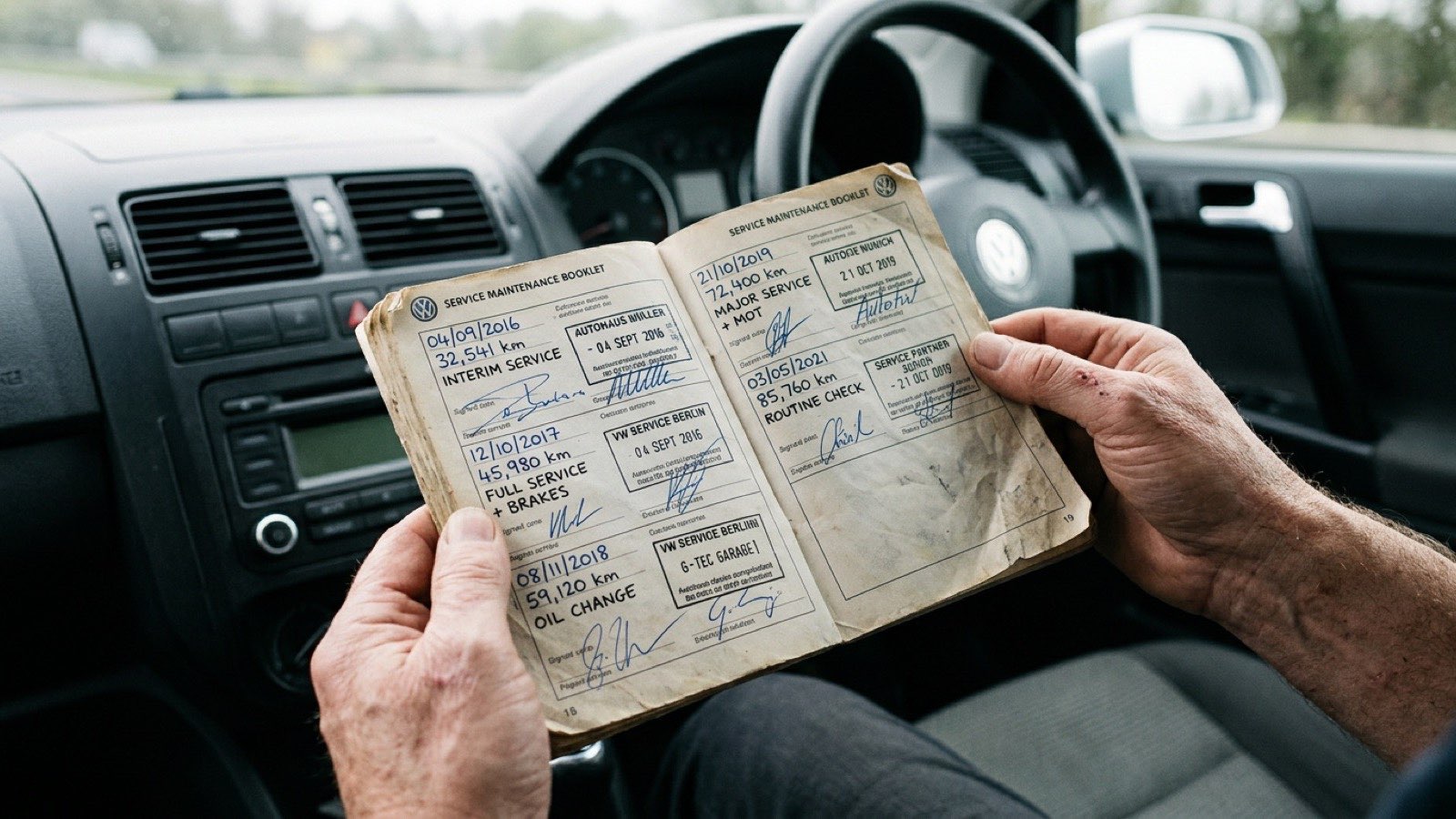
A full service history shows maintenance done at roughly the intervals the manufacturer recommends, with dated receipts or stamps for both routine work and the bigger scheduled jobs. Gaps matter most when they overlap with expensive wear components: a skipped timing-belt or clutch replacement, for example, doesn't just delay a bill, it risks turning a planned repair into a much larger one once the part fails and damages what's around it. A missing book isn't automatically a dealbreaker, but it shifts the burden onto you to verify the car's condition independently.
A full service history shows maintenance done at roughly the intervals the manufacturer recommends, with dated receipts or stamps for both routine work and the bigger scheduled jobs. Gaps matter most when they overlap with expensive wear components: a skipped timing-belt or clutch replacement, for example, doesn't just delay a bill, it risks turning a planned repair into a much larger one once the part fails and damages what's around it. A missing book isn't automatically a dealbreaker, but it shifts the burden onto you to verify the car's condition independently.
Why the service book isn't just paperwork
A service history is one of the few documents in a used-car sale that reflects how the car was actually treated, not just how it looks or drives on a short test. Mileage on its own tells you how far a car has travelled; a service record tells you whether it got the attention that mileage requires along the way. That's why buyers keep coming back to it, and why sellers sometimes gloss over the gaps in it.
1. What a complete service history actually looks like
A genuinely complete record has two layers, and both matter:
- Routine maintenance: oil and filter changes, brake checks, and fluid top-ups, done at intervals that roughly track the mileage between visits.
- Major scheduled jobs: the bigger, calendar- or mileage-triggered replacements the manufacturer specifies, which tend to be the ones sellers are most tempted to skip because they're expensive and don't cause a problem until they do.
Each entry should have a date and, ideally, an odometer reading, whether it's a stamped service book, a workshop invoice, or a digital record from a dealer network. The mileage on each entry is what lets you cross-check the service history against the odometer and against any past roadworthiness or periodic inspection records: if those numbers don't line up with each other, that's a bigger red flag than a maintenance gap on its own.
2. "No book" vs. "incomplete book": not quite the same problem
Both get flagged as risks by maintenance-history guides, but they're not identical. A car with genuinely no records at all is hard to evaluate on paper: you have no baseline, and according to guidance from Karmann Fine Cars, a complete absence of records is treated as a sign the owner may not have prioritized upkeep. An incomplete book, on the other hand, at least tells you something: what work was done, roughly when, and by extension, what's missing. The most concerning pattern isn't a single missing stamp: it's the same repair showing up more than once, which points to an underlying issue that was patched rather than fixed, or a long stretch with nothing logged at all during years the car was clearly being driven.
Practically, treat "no book" as a reason to lean harder on independent verification (inspection, history check, contacting a previous garage if one is named), and treat "incomplete book" as a reason to look specifically at what is missing rather than just counting the gaps.
3. Which gaps matter most: a quick reference
| Type of gap | What it usually signals | How much it matters |
|---|---|---|
| A missed routine oil change or two | Common, often just an owner who self-serviced or switched garages | Minor on its own; check if wear elsewhere matches the story |
| Long gap during the years the car was clearly in daily use | Possible neglect, or maintenance done off the books | Worth asking directly; corroborate with wear and inspection |
| Gap that overlaps a manufacturer-scheduled major job (timing belt, clutch, timing-belt-driven water pump) | The expensive, failure-prone work may be overdue or skipped entirely | High; this is the category most likely to become a dealbreaker |
| Same repair logged more than once | Underlying problem wasn't actually resolved the first time | High; ask what changed between the two visits |
| No records at all, but low mileage and a young car | Less alarming; fewer scheduled services would be due yet | Lower risk, but still worth an inspection to confirm |
| No records at all on an older, higher-mileage car | Little to verify owner care; most uncertainty | High; treat as a car you must independently inspect before buying |
4. Why the expensive-component gaps are the real dealbreakers
Not all missing maintenance carries equal financial risk. A skipped oil change is a nuisance; a skipped timing-belt replacement is a different category of problem, because a belt that snaps in an interference engine can let pistons and valves collide, turning a scheduled, predictable repair into major engine damage: one repair-cost comparison put the failure repair at roughly three to six times the cost of the scheduled belt replacement; exact figures vary by country and by vehicle, but the same order-of-magnitude gap between "planned" and "failure" repair shows up wherever this has been priced out (Chloe's Auto Repair, "Timing Belt Replacement Cost vs. Engine Damage"). Clutch neglect follows a similar pattern on a smaller scale: a slipping clutch that's ignored can overheat transmission fluid and damage seals, bearings, or the flywheel around it, so a repair that could have been a single, contained job turns into a larger transmission repair. These are exactly the items worth asking about directly if the service history is silent on them: not because a gap proves the work wasn't done, but because the downside of assuming it was and being wrong is large.
5. How to partly compensate for missing history
A gap in the paper record doesn't have to be a dead end:
- Ask for the garage's contact details, if any shop name appears in the book: a phone call can sometimes confirm work that wasn't logged in the owner's copy.
- Cross-check mileage across every document you can find: service stamps, past roadworthiness or periodic inspection records, insurance paperwork, to catch inconsistencies that a missing book alone wouldn't show.
- Book an independent mechanic's inspection, especially focused on the expensive, failure-prone components a service gap can't rule out: this is the most direct way to know the car's actual condition regardless of what the paperwork says.
- Pull a vehicle history check: it won't replace a stamped service book, but it can surface accident history, prior ownership changes, and recorded mileage readings that are independent of what the seller hands you at the viewing.
A Plateop report is built to help with that last step specifically, though not by pulling history records from a register itself: it works from the listing, the asking price and verified model knowledge (including which major jobs tend to matter for this model), turning that into something independent to compare against the service book, or its absence, while being upfront about what it can't confirm. Where your market provides official vehicle records, the report uses them and cites the source. Check any car before you buy at plateop.com.
6. Quick checklist for reviewing a service book at a viewing
- Does every entry have both a date and a mileage reading?
- Do the mileage figures increase consistently, with no entry showing a lower reading than one before it?
- Are the big scheduled jobs (not just oil changes) actually present, with receipts you can verify?
- Does any repair appear more than once for the same issue?
- If there's no book at all, does the seller's story match the car's age, mileage, and visible wear?
A service history is a strong signal, not a guarantee. But the gaps that overlap with expensive components are the ones worth walking away from a sale over, or at minimum, getting independently inspected before you sign anything.